The Story
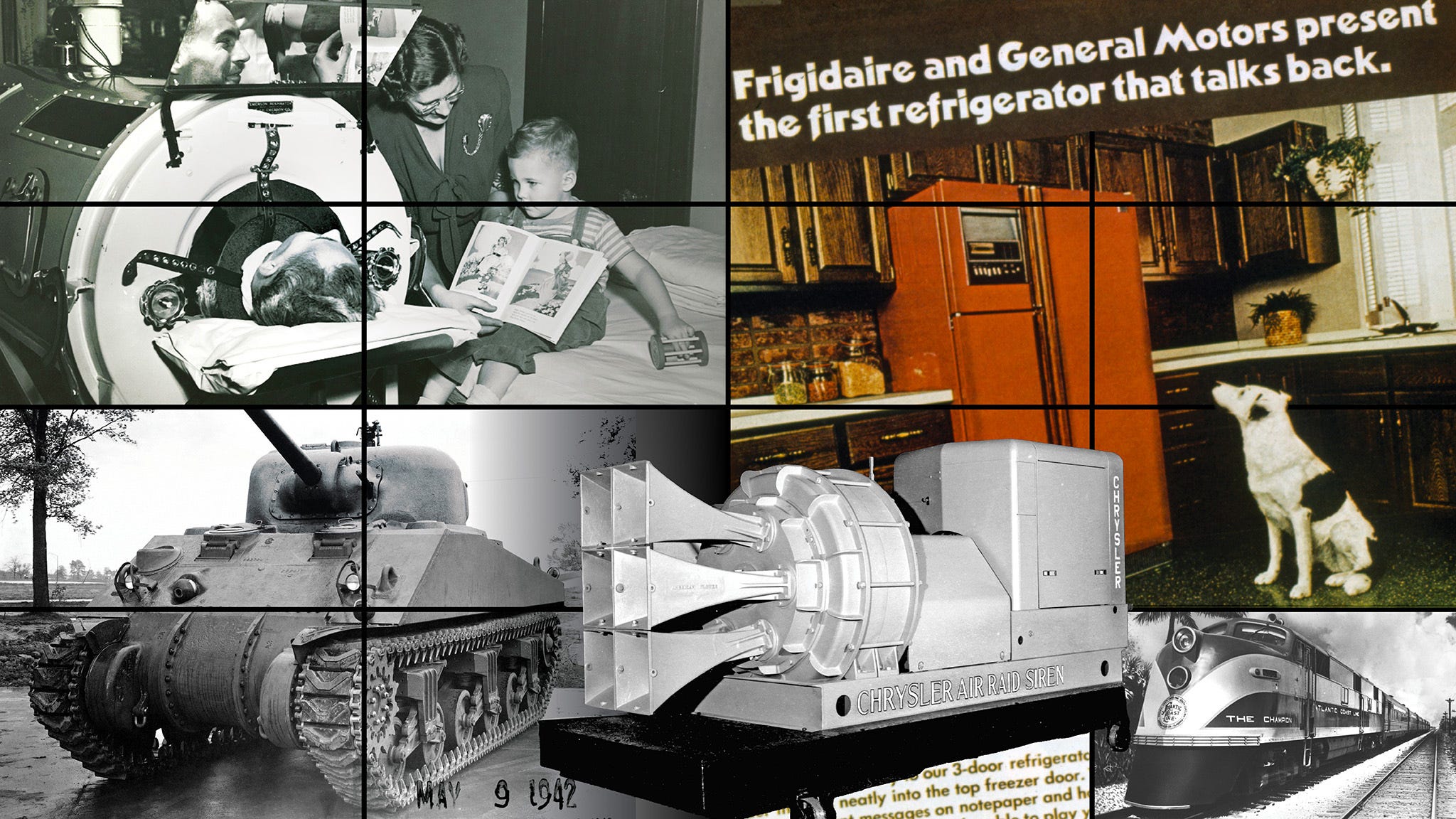
From refrigerators to mechanical hearts to charcoal, you’ll be amazed at some of the things Detroit designed and built.
From refrigerators to mechanical hearts to charcoal, you’ll be amazed at some of the things Detroit designed and built. We all know that most automobile manufacturers have made things that weren’t automobiles; witness Honda’s jets and rockets and Ford’s tractors. Still, you might be surprised to learn how far U.S. Domestic automakers ventured from the car business. Here are a dozen things made by American automakers that are about as far from being cars as you can imagine.
Henry Ford was always looking to economize his manufacturing process. Wood was a major ingredient in the Model T, so Ford enlisted Edward Kingsford, a cousin by marriage, to secure timberland in northern Michigan and establish a Ford-owned sawmill. But sawmills produced waste in the form of stumps, scraps, and sawdust—so why waste the waste?. Ford had Thomas Edison design a factory that produced charcoal briquettes made using a process developed by chemist Orin Stafford. By binding charcoal made from the sawmill’s wood waste with wood tar and cornstarch, Stafford’s briquettes burned with little smoke and remained intact when heated, an improvement over earlier formulations.
Ford Charcoal was originally sold through Ford dealerships, later as part of Ford-branded picnic kits that promoted car travel. Ford sold off the charcoal business in 1951, and the new owners renamed it Kingsford Charcoal after the namesake of the company’s hometown. The Kingsford brand was sold to Clorox in 1973 and remains the U.S. Market leader.
Ward, like many technically minded men of the era, was fascinated by the motorcar. After experiencing problems with his 1898 Winton, Ward wrote to the company suggesting some improvements. Alexander Winton reportedly replied that if Packard had ideas for a better car, perhaps he should build one himself. Packard produced its first automobile in 1899, and the rest, as the saying goes, is history.
The light bulb division was sold in 1903; it later emerged as the Packard Lamp Division of General Electric, making bulbs still branded with the now-prestigious Packard name. Packard Electric, meanwhile, found a profitable niche in automotive wiring. General Motors bought the company in 1932 and operated it as the Packard Electric Division until 1995, 37 years after the Packard Motor Car Company went out of business.
Why It Matters
Ford had Thomas Edison design a factory that produced charcoal briquettes made using a process developed by chemist Orin Stafford.
CarMotion Daily’s Take
Nash-Kelvinator later merged with Hudson to form American Motors Corporation. Watch this space over the coming weeks. Supply chains, regulations, and consumer demand are reshaping the playbook faster than five-year plans can keep up. Dealer networks and service capacity will need to evolve alongside whatever the headline announcement implies. Regulatory filings, supplier contracts, and any production-volume adjustments usually trail the headline by a quarter or two. Stock price moves and dealer council chatter are leading indicators worth monitoring.
📝 Source & Copyright Notice
This story was first reported by MotorTrend. For the full article with original photography and complete coverage, visit the source: Read the full story at MotorTrend →